
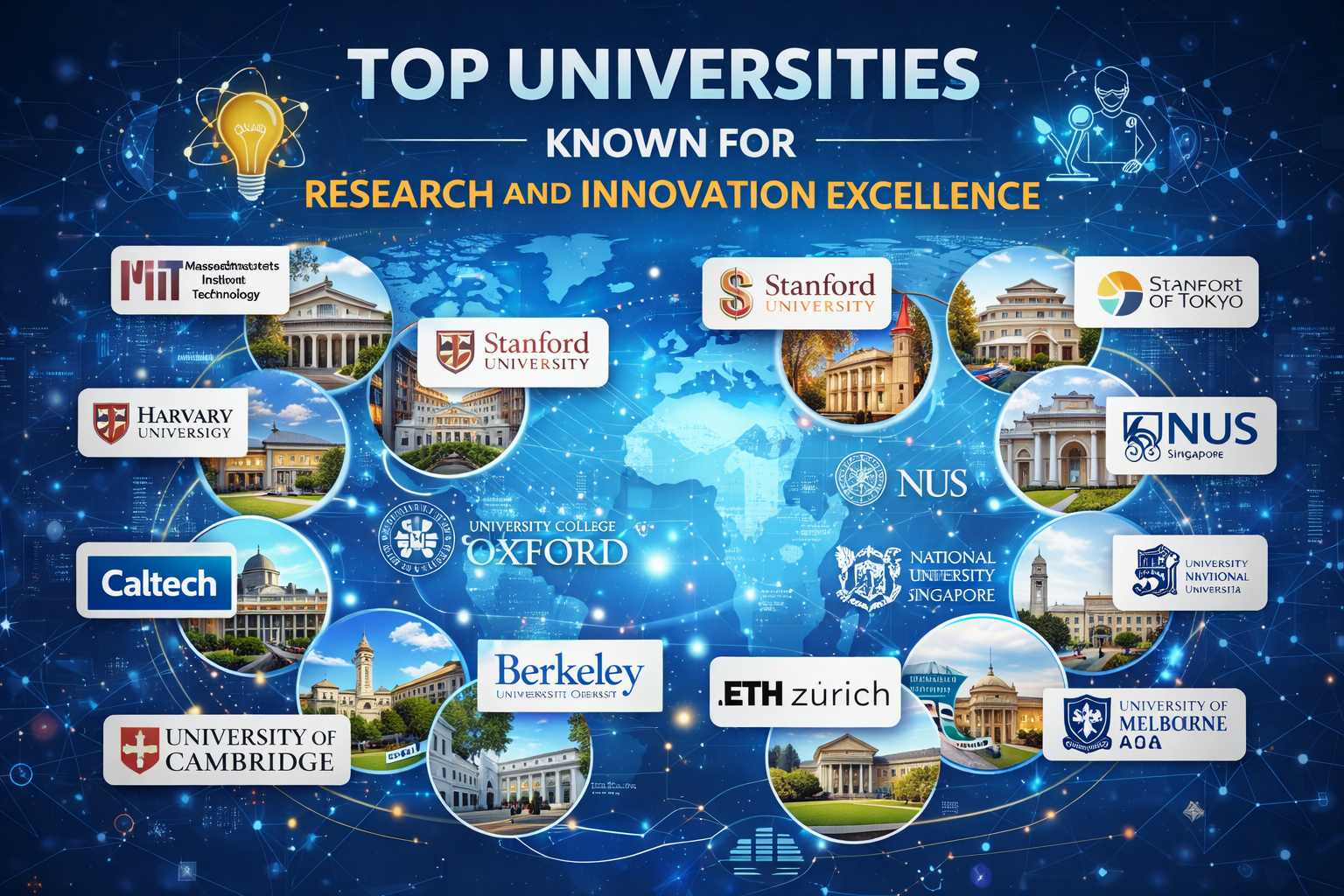
Innovation has become the defining force behind modern education, and universities that lead in research are shaping the technologies, medical breakthroughs, and scientific discoveries that transform society. These institutions not only deliver academic excellence but also cultivate environments where creativity, collaboration, and experimentation thrive.
From artificial intelligence and biotechnology to sustainability and space exploration, the world’s top research universities continue to push boundaries and influence global progress. Below is a selection of institutions widely recognized for their commitment to research and innovation.
Massachusetts Institute of Technology (MIT)
MIT has long been synonymous with groundbreaking innovation. Its laboratories and research centers drive advancements in robotics, nanotechnology, artificial intelligence, and renewable energy. The institute’s entrepreneurial culture has also led to the creation of numerous startups that reshape global industries.
Stanford University
Situated near Silicon Valley, Stanford stands at the intersection of academia and industry innovation. Its research contributions span AI, biotechnology, business innovation, and engineering. Stanford’s ecosystem fosters collaboration between students, faculty, and technology leaders, making it a launchpad for transformative ideas.
Harvard University
Harvard’s research strength lies in its interdisciplinary approach, covering medicine, economics, law, and social sciences. Its research institutes play a key role in addressing global health challenges, policy development, and technological innovation.
University of Cambridge
With a history of scientific discovery dating back centuries, Cambridge continues to lead research in physics, biotechnology, and clean energy. Its innovation centers support academic-industry partnerships and encourage startup development.
University of Oxford
Oxford’s research impact is evident across medicine, the humanities, and engineering. Its collaborative research model has contributed to significant breakthroughs, including advancements in global healthcare and vaccine development.
California Institute of Technology (Caltech)
Caltech’s focused research environment produces remarkable discoveries in astrophysics, quantum science, and environmental studies. Its management of major space research initiatives highlights its leadership in scientific exploration.
ETH Zurich
ETH Zurich stands as a European powerhouse in engineering and environmental science research. Its strong connections with industry and cutting-edge laboratories enable pioneering work in robotics, architecture, and digital innovation.
University of Tokyo
The University of Tokyo is a leader in Asia’s research landscape, contributing to advancements in robotics, materials science, and medical technology. Its collaboration with Japan’s technology sector strengthens its global influence.
National University of Singapore (NUS)
NUS has established itself as a hub for research in sustainability, artificial intelligence, and biomedical innovation. Its global partnerships and innovation initiatives position it among Asia’s most influential universities.
Tsinghua University
Tsinghua University is widely recognized for engineering and technology research. Its rapid growth in innovation output reflects China’s increasing role in global scientific advancement.
University of California, Berkeley
Berkeley’s research achievements span computing, environmental science, and chemistry. Its culture of academic freedom and innovation has led to discoveries that shape modern technology.
Imperial College London
Imperial’s research strengths in science, medicine, and engineering support solutions to global challenges such as climate change and infectious diseases. Its innovation ecosystem promotes collaboration across disciplines.
University of Melbourne
The University of Melbourne contributes significantly to biotechnology, medical research, and sustainability studies. Its research centers and global collaborations enhance innovation across the Asia-Pacific region.
Seoul National University
Seoul National University excels in robotics, digital technology, and advanced engineering research. Its partnerships with leading technology firms help translate academic research into practical innovation.
KU Leuven
KU Leuven is one of Europe’s most productive research universities, particularly in pharmaceuticals and biotechnology. Its innovation culture supports startup growth and interdisciplinary discovery.
Why Research Excellence Matters
Research-driven universities serve as engines of global progress by:
-
Driving technological breakthroughs
-
Addressing complex global challenges
-
Advancing healthcare innovation
-
Supporting economic development
-
Preparing future innovators and leaders
These institutions demonstrate how academic research translates into real-world impact.
Student Advantages
Students attending research-intensive universities benefit from:
-
Access to advanced laboratories
-
Opportunities to collaborate with experts
-
Participation in funded research projects
-
Exposure to interdisciplinary innovation
-
Strong career pathways in academia and industry
Conclusion
Universities that prioritize research and innovation play a crucial role in shaping the future of science, technology, and society. Institutions such as MIT, Stanford, and Oxford exemplify how academic excellence combined with innovative thinking can drive transformative change. For students and researchers alike, these universities offer unmatched opportunities to contribute to discoveries that influence the world.
FAQs (Short & Simple)
1. What defines a research-focused university?
Strong funding, advanced facilities, high publication output, and global collaboration.
2. Do research universities offer opportunities for international students?
Yes. Most provide research funding, scholarships, and collaborative programs for international students.
3. Which fields dominate research innovation today?
Artificial intelligence, biotechnology, sustainability, robotics, and medical science.
4. Is studying at a research university beneficial for careers?
Yes. It provides practical experience, industry connections, and enhanced employment opportunities.
